
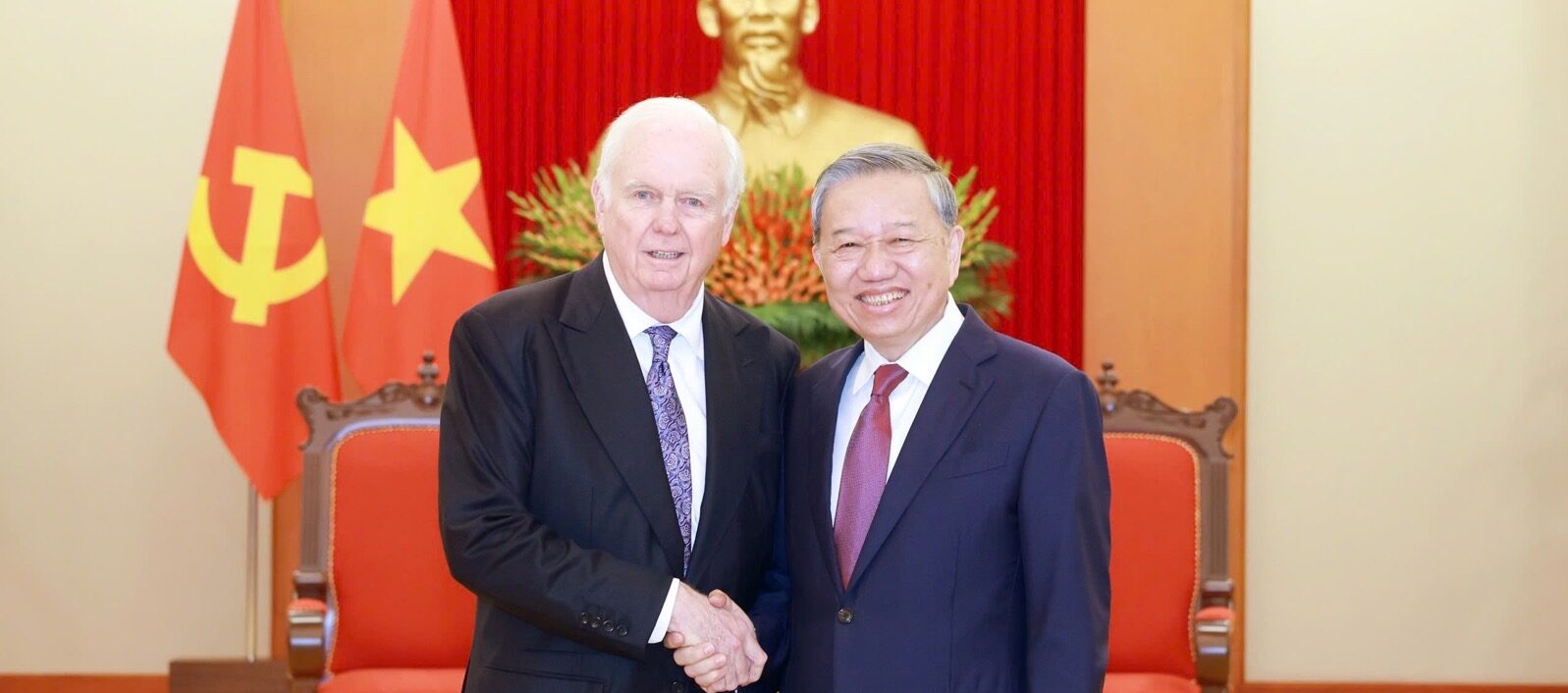
Thomas Vallely meets General Secretary Tô Lâm in Hanoi, March 2025 – Photo: VNA
In November 2025, Thomas Vallely, Senior Advisor for Vietnam at Columbia University’s Weatherhead East Asian Institute, and founder of the Fulbright Economics Teaching Program as well as Fulbright University Vietnam, returned to Vietnam to deliver a series of lectures titled “In Search of the Narrow Corridor.”
(Originally published in Tuổi Trẻ Newspaper, Lunar New Year Issue 2026. Author: Trọng Nhân)
At the age of 75, Vallely continues to travel between the two countries, closely following Vietnam’s progress across politics, society, the economy, education, and culture. On the occasion of the Lunar New Year of the Horse, Tuổi Trẻ spoke with him about this return journey.
A “POLICY SYMPHONY”
At a time when Vietnam is aspiring toward a historic moment of national breakthrough, where do you see the country on the development map of Asia and the world?
In November 2025, I returned to Vietnam to deliver a lecture series titled “In Search of the Narrow Corridor.” The title draws inspiration from two sources. The first is the policy report “In Search of the Dragon’s Trail,” prepared by the Harvard Institute for International Development (HIID) for the 8th National Party Congress in 1996. The second is The Narrow Corridor (2019) by Daron Acemoglu and James Robinson, part of the body of work that earned them the 2024 Nobel Prize in Economics.
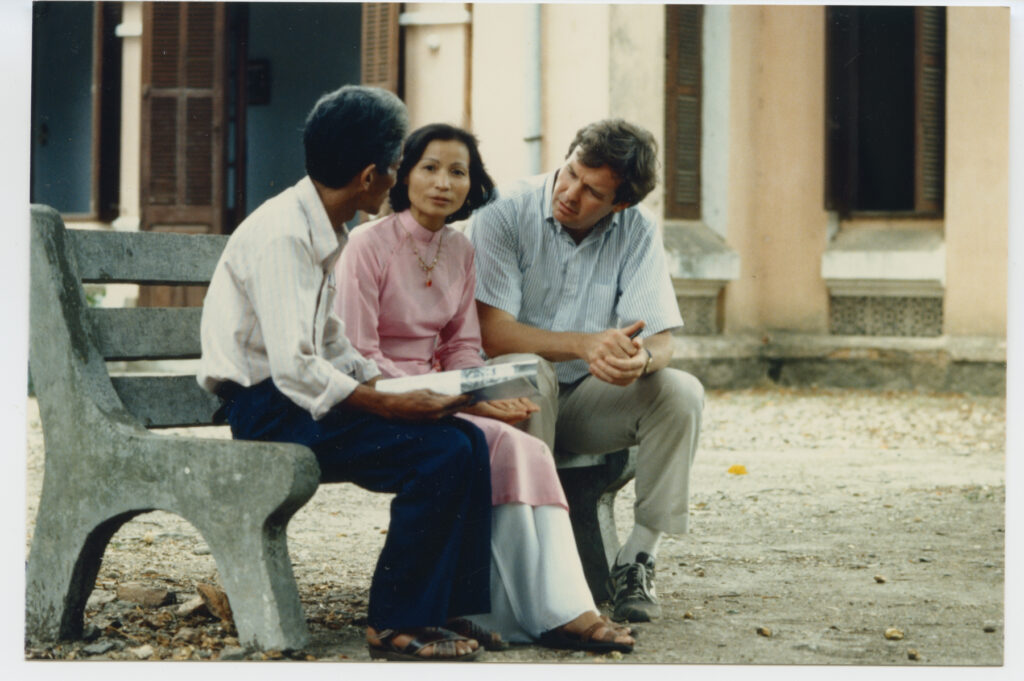
Vallely (right) during a visit to Vietnam in 1989 – Image reproduced from the original source by Hien Le
Metaphorically speaking, the “Dragon’s Corridor” refers to the East Asian development model pursued by economies such as South Korea, Taiwan, Japan, and Singapore. Viewed from today, Vietnam can be seen as a rising “middle power.” Its economy is relatively dynamic: while the domestic private sector remains small, foreign direct investment flows are substantial. Vietnam has addressed many early-stage development challenges, and over a long period, reforms since 1986 have transformed the country in profoundly positive ways—raising living standards and shaping a modern Vietnam.
From another perspective, today’s Vietnam reflects the outcomes of state deregulation. Reforms reduced the state’s direct role in key nation-building sectors such as agriculture, telecommunications, banking, and aviation, helping to form an open economy through the removal of regulatory barriers.
However, this is still not enough, as other major economies have moved much faster. Vietnam has done well, but it now needs a new idea, and in my view, that “new idea” is already being actively discussed.
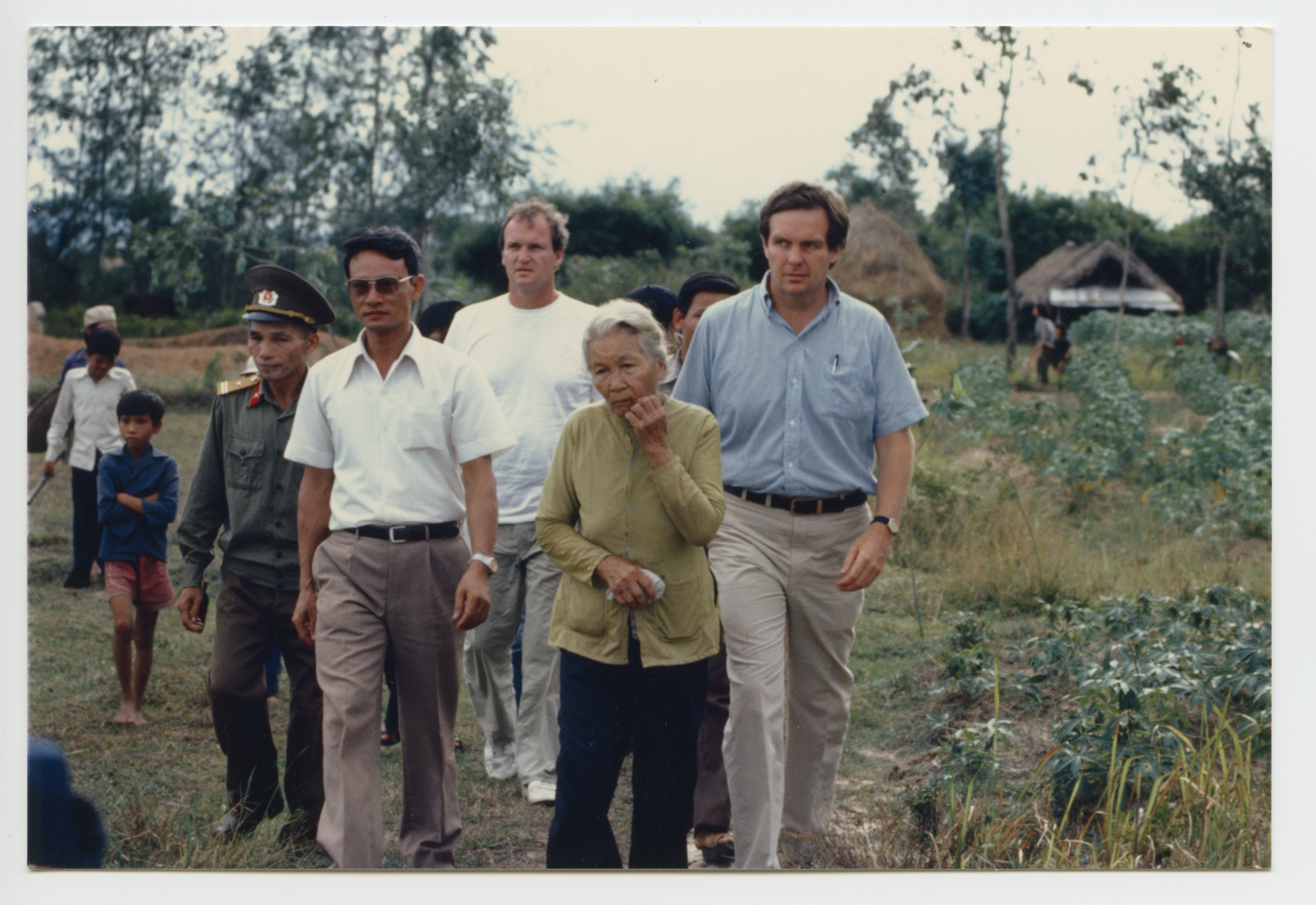
Thomas Vallely (far right), a former U.S. veteran, during a visit to meet Vietnamese war veterans in 1985. – Courtesy of Thomas Vallely
Personally, I often describe Vietnam’s recent national policy decisions as a “symphony.”
The first “movement” is the combination of key resolutions: 57, 71, 66, and 68 carefully constructed pillars that address core policy challenges.
The second movement focuses on a major unresolved challenge: energy. Unlike other sectors, energy has not been deregulated. In the future, national power will depend on two things: large-scale data centers and AI infrastructure, alongside affordable and reliable electricity.
The third movement continues Vietnam’s strategy of economic integration, embedding the country more deeply into the global economy. This is a sound strategy—leveraging Vietnam’s international standing while also functioning as a form of “new non-alignment,” preserving strategic space between major powers.
The fourth movement concerns culture—an effort to renew and revitalize Vietnam’s cultural life.
If this policy symphony is conducted well, it will be critically important for Vietnam’s future. But it will also require a stronger bottom-up mechanism, similar to the post-1986 reform period. Greater public participation is needed to turn policy direction into lived reality, not merely written text.
What did your journey of “Searching for the Dragon’s Trail” look like?
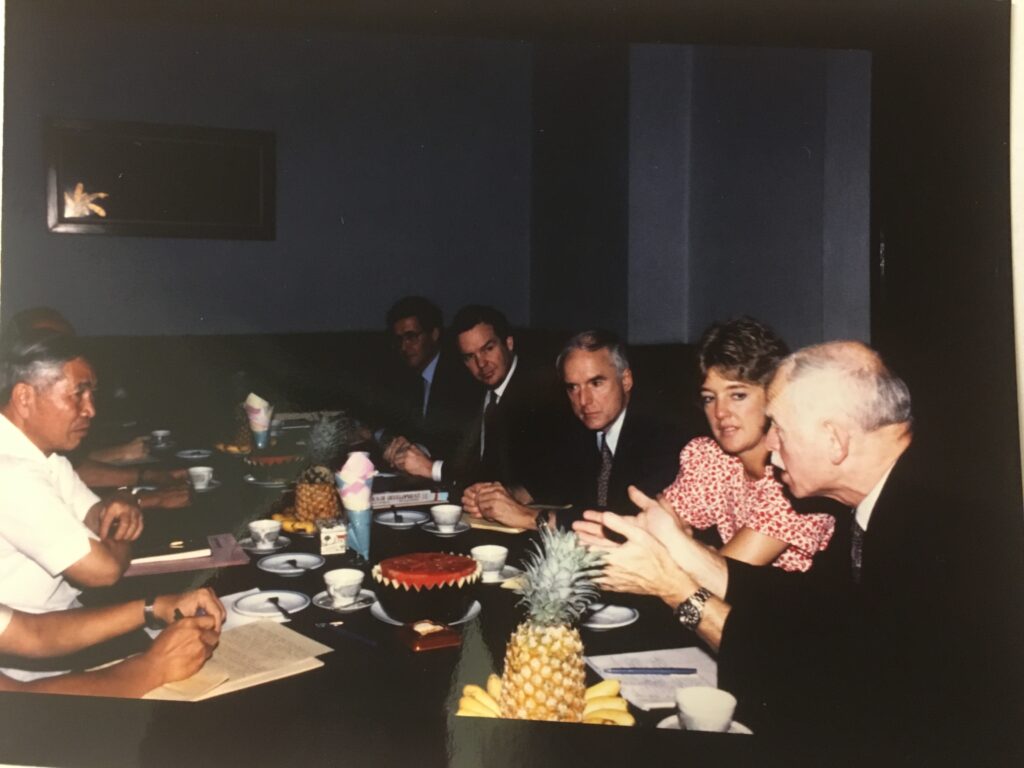
Former Foreign Minister Nguyễn Cơ Thạch meets a Harvard delegation, including Thomas Vallely, in 1989 – Image reproduced from the original source by Hien Le
In the late 1980s, I traveled with the late Prime Minister Phan Văn Khải—then Minister of Planning and Investment—and a group of officials to Indonesia and South Korea, and later with another group to Thailand and Taiwan. We were searching for an answer to a fundamental question: How could Vietnam become an “Asian Tiger”?
We called this journey “Searching for the Dragon’s Trail”—seeking to understand how Vietnam could follow the development paths of East Asian economies such as South Korea and Taiwan. I have always believed that Vietnam should pursue a strategy closer to that of an East Asian country rather than a typical Southeast Asian one. Southeast Asia, broadly speaking, has been less successful in industrial and technological development. If Vietnam hopes to realize the vision of Resolution 57, it must rise beyond the model of a typical Southeast Asian country and move closer to the East Asian model of high-tech economies.
Those trips may have contributed, in some measure, to how Prime Minister Phan Văn Khải and other leaders implemented the decisions of the 6th and 7th Party Congresses in ways more aligned with the East Asian model—though, of course, not everything could be accomplished. What remains today, in my view, is the task of the new “policy symphony” Vietnam is now pursuing, to move the country one step further forward.
EDUCATION REFORM AND RETAINING TALENT
As someone who has contributed tirelessly to Vietnamese education through founding the Fulbright Economics Teaching Program and Fulbright University Vietnam, what would you recommend for Vietnam’s education system?
Vietnam has notable strengths. For example, there is a world-class community of Vietnamese AI scientists, most of whom currently live and work abroad. Vietnam’s K–12 STEM education is highly regarded. Above all, the country possesses tremendous social energy—a strong spirit of learning and rapid adaptation—which has been the core driver of the extraordinary economic transformation I have observed over four decades of studying Vietnam.
However, one of Vietnam’s greatest weaknesses lies in an inefficient university system, coupled with an inward-looking governance culture in which personal relationships are sometimes prioritized over innovation capacity and the vision of younger generations—despite the fact that these young people are already proving themselves on the global stage.
Vietnam needs a well-differentiated higher education system, where institutions have clear, complementary roles—especially a small number of leading universities focused on teaching and creative research. At the same time, Vietnam should encourage new educational models to serve as catalysts for institutional reform in higher education.
China’s experience, and to some extent India’s, shows that globally competitive talent can play a breakthrough role in building a strong domestic technology ecosystem. Vietnam can learn from this by proactively engaging the global Vietnamese tech community—listening to their needs and creating conditions for them to work, collaborate, and contribute to the country.
If many world-class Vietnamese AI scientists are working abroad, what mechanisms does Vietnam need to retain talent?
If you become a highly skilled engineer, chances are you will leave Vietnam because domestic mechanisms and demand are not yet sufficient to fully utilize your capabilities. But if too many talented people continue to leave for Silicon Valley, Singapore, or other hubs, this becomes a serious problem.
At a macro level, one important step Vietnam can take is to keep society more open—to more fully embrace the “narrow corridor,” meaning a balanced space between state power and social freedom. Only then can Vietnam become an advanced technology economy capable of fully leveraging its high-quality human capital.
Experts say Vietnam–U.S. relations are entering a “third phase” focused on technology, energy, and AI. What do you expect from this cooperation?
I would say that Vietnam has managed the transition from the administration of President Joe Biden to the current administration of President Donald Trump quite effectively. Vietnamese leadership deserves recognition for the skillful way it has responded to the Trump administration’s trade tariff policies.
I believe that if the two countries were to enter a “third phase” of their relationship—one grounded in cooperation around knowledge, technology, and institutional reform—this would be the most formative phase yet, not only for Vietnam’s future but also for the role of education in the bilateral relationship.
As I mentioned earlier, Vietnam is currently in a particularly vulnerable position due to a significant technological gap with many other countries. To narrow this gap, in my view, three key factors are essential. First, improving the quality of human capital through education and the inflow of knowledge—that is, opening up to attract talent, technology, and new ideas. Second, strengthening the capacity of the private sector, which serves as the primary engine of innovation and economic competitiveness. Third, developing critical national strategic infrastructure, including energy and power systems, as well as hyperscale cloud computing platforms—an essential foundation for operating a modern digital economy and an AI-driven industrial base.
In reality, China has long surpassed Vietnam in these areas. This presents Vietnam with a challenge of existential significance, but at the same time, it offers an opportunity to reposition itself in the emerging technological era.
“I HAVE LEARNED SO MUCH FROM VIETNAM”
You have been connected to Vietnam for over 55 years. Looking back, what have you learned from the country?
I feel incredibly fortunate in my career. I have learned a great deal from Vietnam, and through it, I have come to better understand the world. Had I stayed in politics, I might have become merely a U.S. congressman—understanding America, but not how the world truly works. (Thomas Vallely served as a Massachusetts State Representative from 1980–1987.)
Through Vietnam, I have understood the position of a developing country in the global environment and learned to see the world from a different perspective—one that is more nuanced, complex, and human. I believe that as long as Vietnam’s political system maintains harmony among the state, society, academia, and business, the country can preserve genuine independence and autonomy in a turbulent world.
I have never felt lonely in Vietnam. What I sometimes feel is disappointment—because Vietnam has faced extraordinarily complex challenges and has missed opportunities in the past. For me, I never, ever want to see Vietnam fail.
Please download the PDF file of the article HERE.