
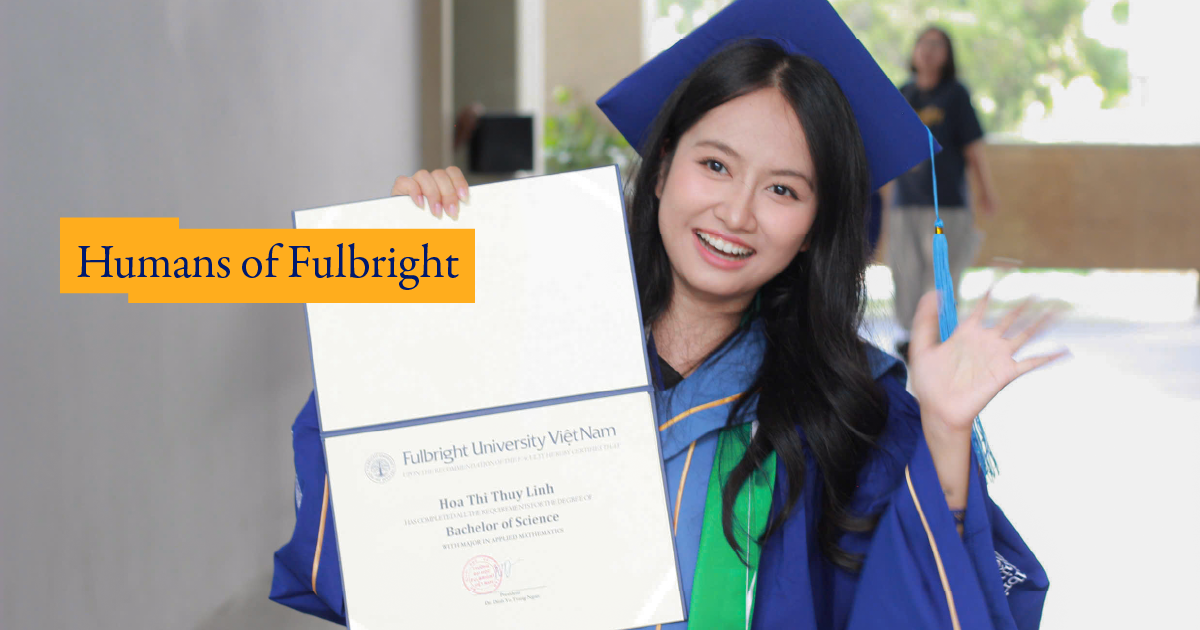
A conversation with Thuy Linh, an Applied Mathematics alumna at Fulbright University Vietnam and currently a Data Scientist at Tasco Group, about overcoming prejudice to rediscover her pure love for Mathematics.
Recently, reading the news about mathematician Hong Wang being awarded the 2026 Fields Medal—becoming only the third woman to receive this honor in its 90-year history—Thuy Linh felt not only profound admiration for an extraordinary milestone, but also reflected on her thirteen-year-old self, who was once told: “There’s no point in a girl studying math.”
Her journey—from a young girl doubting her own abilities, wandering through different disciplines, and finally returning to Applied Mathematics at Fulbright University Vietnam—is Thuy Linh’s gentle yet resolute answer to the question: Can a girl go all the way with Mathematics?
Join Fulbright in this inspiring conversation with Thuy Linh.
Throughout your journey growing up, what has Mathematics meant to you?
My love for math took root early on because my mother was a middle school math teacher. Before I could even read or write, I had already memorized trigonometric formulas as rhymes, toddling along while listening to my mother tutor older students. To my childhood self, math was wonderfully pure: sitting beside my mother as she taught, keeping a dedicated notebook for unsolved problems to tackle later at home, and above all, that sheer, overwhelming joy when I finally cracked a tough equation.
As I grew older, however, math took on heavier meanings.
The pressure to prove myself in competitive environments turned math into a label. I feared that failing to solve a problem meant losing my own worth. Compounded by disparaging remarks about girls doing math, I began second-guessing myself: Was I only quick because my mother taught me from an early age? Without her, would I truly be good at this?
The turning point came in eighth grade during a gifted-student competition in Civic Education, with an essay prompt: “What is the purpose of learning?” What surprised Thuy Linh was how deeply the lesson reached beyond the boundaries of the subject. She began actively untangling her self-worth from test scores and the title of “math prodigy.” I realized I loved the learning process itself—sitting patiently with an unresolved question—rather than just the validation that came with it.
Did you choose to major in Mathematics right when you entered university?
To be honest, when I started college, I didn’t dare choose Math. I was terrified of going back to the days of tying my entire self-worth to an outcome, afraid that childhood wonder would once again drown in the pressure to prove that I belonged. Initially, I planned to pursue Computer Science and Psychology.
Fortunately, Fulbright’s interdisciplinary education gave me the space to explore diverse fields. I chose Psychology initially to understand my inner wounds and learn how to manage stress, never imagining it would connect back to Math. Yet that very process of untangling my mind helped me realize: what I had feared all along wasn’t Math, but the obsession with proving myself. Once those labels were stripped away, I was able to return to Math in the most natural way.
It happened during the first semester of my sophomore year in the Data Analytics with R class taught by Dr. Le Nhat Tan. The evening he lectured on Linear Regression and encouraged the entire class to prove the formula ourselves, I stayed at university until 10 PM debating with classmates in sheer excitement.
That single session didn’t instantly make me a math genius, but it rekindled that original childhood spark: the joy of pursuing a question to its very end. My mother once told me: “Maybe you just need to spend more time with your mistakes. When something feels uncomfortable, bear with it a little longer.” Fulbright provided a safe environment for me to look patiently at what I didn’t yet know, without labeling myself as inadequate.
Could you share a bit about your work after graduation?
I have always hoped that what I learned from Applied Mathematics wouldn’t remain confined to textbooks or stored away in static PDF files, but could touch real-world problems. That is why I chose to work alongside product development teams, where I can help translate research insights into actionable solutions.
Currently, I am a Data Scientist on the Map Team at Tasco Group Vietnam. My work revolves around data, research, and building models to optimize map data for transportation and mobility challenges. I am still in the early stages, with many models left to master and undoubtedly more mistakes to make. Each misstep is an essential lesson—learning how to turn ambiguous questions into observable, verifiable data, and in doing so, creating tangible impact every single day.
If you could offer one piece of advice to young women who doubt their ability to pursue Mathematics, what would it be?
Math isn’t just for people who always have the right answer. Math is for the curious, for those patient enough to stay with a problem a little longer, and for the girls who were once told that this place wasn’t meant for them, yet chose to stay anyway. Sometimes, all it takes is gathering enough courage to take the next step—momentum will take care of the rest.
Perhaps that is why the news of Hong Wang receiving the Fields Medal moved me so deeply. It serves as a resounding confirmation to that thirteen-year-old girl that she has every right to believe she belongs here.