
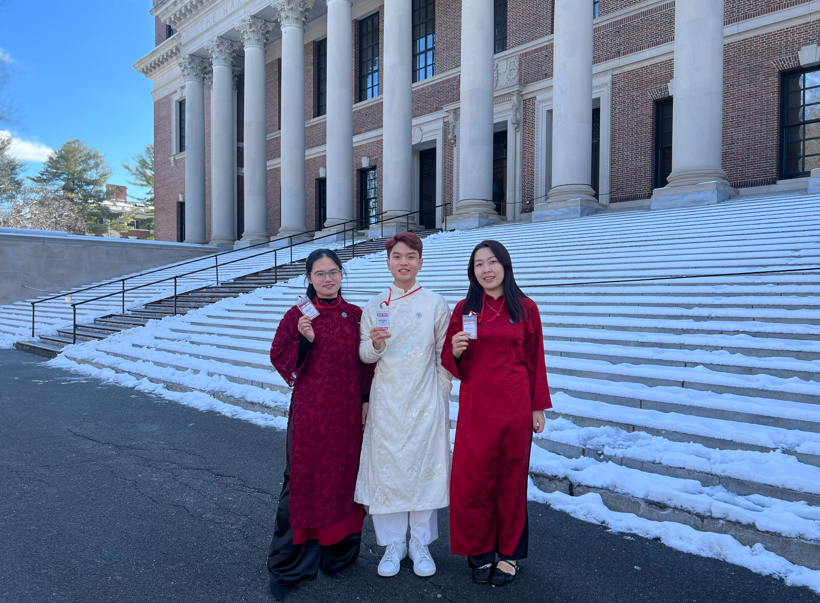
In January, three students from Fulbright University Vietnam – Nguyen Phan Quang Anh, Le Thi Hong Phuc, and Le Khanh Huyen – represented Vietnam at the Winter Conference of the Harvard Undergraduate in Asia Program 2026 (HUAP), a one-week academic and cultural exchange program held at Harvard University, United States.
HUAP brings together students from Harvard and leading universities across Asia for a series of discussions on topics such as innovation and sustainable urban development, mental health, law, artificial intelligence, and healthcare. In this academic setting, Fulbright students not only came to learn but also brought with them academic interests rooted in the Vietnamese and regional contexts.
Bringing Vietnam’s Perspectives Into International Dialogue
One of the key activities at HUAP is the national presentation session, where each student delegation presents a major issue from their home country.
For Quang Anh, this was an opportunity to situate domestic issues within a global context. He shared that by listening to other delegations discuss topics such as housing crises, gender equality, and food security, he realized that each country approaches similar challenges differently depending on its cultural and social context. This experience helped him understand that an academic issue can only be fully understood when examined within specific contextual settings.

Hong Phuc viewed HUAP as a space where Vietnamese students could contribute perspectives from a developing economy. In her view, it is precisely these lived experiences from different national contexts that enrich academic exchanges and help international students better appreciate the diversity of global challenges, as well as the importance of dialogue and collective efforts in addressing them.
Interdisciplinary Approaches: At The Intersection Of AI, Law, And Psychology
The discussion sessions at Harvard were designed with an interdisciplinary approach, encouraging students to connect knowledge across different fields.
As a Psychology student, Hong Phuc was particularly impressed by the session on artificial intelligence (AI) in education and healthcare. From a behavioral science perspective, she came to see that AI is not merely a technical tool but also raises questions about algorithmic bias and the limitations of data. After the program, her research approach shifted toward a more interdisciplinary direction: she now considers not only human emotions but also the roles of technology and policy in shaping those emotions.

For Khanh Huyen, the session “The Diverse World of Law” offered deeper insight into the connections between law and other areas of society. Through case analysis exercises, she engaged with issues such as data privacy and the limits of law enforcement authority, gaining a clearer understanding of the role of law in modern life.
Critical Thinking In A Multicultural Setting
Discussion groups at HUAP were randomly assigned and brought together students from different Asian countries. This created exchanges in which the same issue could be viewed through multiple social experiences.
Quang Anh noted that in such an environment, differences in viewpoints were inevitable. However, a shared spirit of intellectual curiosity and active listening allowed discussions to become more substantive, helping students find common ground and better understand one another’s cultures.
Khanh Huyen observed that multicultural discussions not only strengthened critical thinking but also taught students how to collaborate with respect and openness, which are essential conditions for meaningful global dialogue and collective problem-solving.

Understanding Oneself To Confidently Engage With The World
For all three students, the academic conference at Harvard represented a continuation of the academic dialogue and intellectual curiosity they are cultivating at Fulbright: asking questions, comparing perspectives, and relating issues to the Vietnamese context. These practices enable them to confidently step into regional and global conversations, where knowledge is closely connected to people and to the shared challenges of society.