

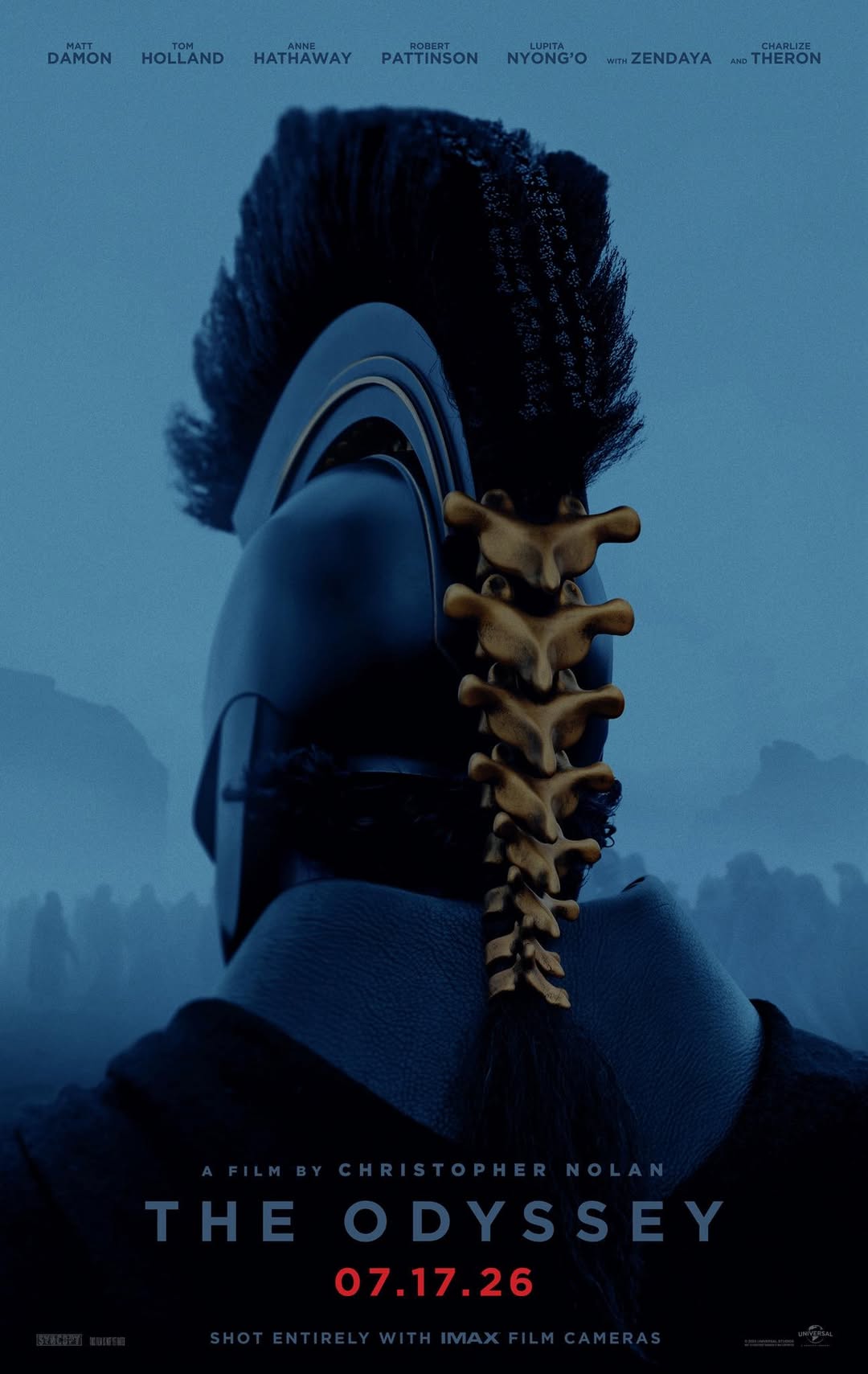
“As someone who regularly teaches Homer’s Odyssey to students, I watched Christopher Nolan’s most recent adaptation of the text with interest last week. Viewers have been buzzing about Odysseus’ line at the end of the film: “To burn the walls of Troy was to burn the world-entire.” But in a blink-and-you’ll-miss-it voiceover in the final seconds of the film, as the hero sails away from the devastation he has left behind, Odysseus tells Penelope that, despite the horror, songs of their exploits will be retold for generations after. Penelope asks, “why will the stories only be sung?”, and Odysseus replies:
O: Because song will be all they have to remember those of us who could write.
P: Civilization will rise again.
O: And dawn will break over the darkened world. And our mistakes will once again be forgotten.
Odysseus’ commentary about the impending loss of literacy (the ability to read and write) mirrors historical reality. The great Mycenaean era, during which Homer’s Iliad, The Odyssey, and the fall of Troy supposedly took place, began to collapse in the 12th century BCE. By 1050 BCE, the empire had all but disappeared. Populations shrunk, palaces were destroyed, and most importantly, Linear B – the written form of Greek – disappeared, leading to the Greek Dark Ages. For hundreds of years, Greece lost the ability to write. Only by the 8th century BCE did the Greeks become literate again with the development of Phoenician Greek, a much-simplified version of their alphabet. It is from this era that we have our earliest accounts of Homer’s Odyssey. Scholars have therefore struggled to accurately date the Odyssey and to answer the question: was Homer himself illiterate? Was The Odyssey sung or written? When and who was Homer?
Watching The Odyssey this week, I found myself making obvious comparisons to the modern world. Why do we tell stories at all? How does storytelling let us remember, and learn from, our mistakes? In both the film and the epic poem, Odysseus and Telemachus simultaneously dread and love the idea of storytelling. In one scene in the movie, Telemachus stops the bard from singing about Odysseus and the Trojan horse; in the original poem, Odysseus hears the tale of Troy sung and openly weeps. But the final scene of the film seems to suggest that reading is an essential byproduct of civilization. The fall of Troy and the collapse of the Mycenaean civilization are intwined with the loss of literacy. If Nolan’s Odyssey is an Odyssey for the modern moment, it feels the most urgent in this commentary. Should we consider the decline of literacy a marker of the decline of our own civilization?
In an age of technological innovation, teachers and even governments are becoming increasingly panicked about the loss of literacy. A recent article in The Atlantic proclaimed that “The End of Reading is Here,” and studies note that the number of Americans who have read a full book has decreased from 55% to 49% in only 10 years.[1] High school teachers are assigning more than 25% less reading than they did 15 years ago and almost no full texts, instead focusing on excerpts.[2] Students’ ability to focus on difficult or long texts has plummeted.[3] In the US, over 50% of people read below a sixth-grade level, which means that while they might be able to read words and sentences, they struggle to effectively interpret what they’re reading, make inferences, or parse complex texts and ideas.[4] Is the invention of AI, and short form technologies like social media, infinite scroll, smart phones, and algorithmic technologies, analogous to the fall of Troy?
Of course, there is an irony to Nolan making this commentary. Nolan himself is participating in the process of transforming textual literacy into media/visual literacy, transforming a notoriously complex, long, written poem into a more easily-digestible visual form. Indeed, Nolan has been critiqued for simplifying The Odyssey (a poem characterized by the moral ambiguity of its characters and the “complicated” nature of Odysseus) into something more easily digestible—an endlessly sympathetic Odysseus, Penelope, and Telemachus, contrasted with the villainous Antinous and suitors.[5] Moments from the original text that complicate the moral landscape, like the hanging of the slave girls, the Nobody episode, and Odysseus’ more complex relationships with Circe and Calypso, are not included in the Nolan version. Adapting books into film has a long and worthy history, and they can drive viewers back to the original texts or bring new, fascinating interpretations of the original. But if we are rapidly becoming only capable of watching the filmic versions and losing the ability to read and focus on the written versions, how will storytelling change? What will happen to our ability to remember and recount our mistakes?
At the end of the film, Penelope and Odysseus optimistically believe that “civilization will rise again.” That we will emerge once more, literate, and “dawn will break over the darkened world.” But Odysseus also suggests that by the time it does, “our mistakes will once again be forgotten.” Here, the hero seems to long for forgetting. But as a reader, this is a moment in which I think that our hero ultimately fails. Earlier in the film, Odysseus begs Calypso to help him remember, even if it comes with pain; he recognizes the importance of remembering and recording. At the very final moment, however, he seems to lose sight of the importance of memory, of recording, and of telling stories. As I watch the Odyssey in 2026, I wonder: what will be forgotten when (or if) we come back to literacy? Can the loss of literacy and remembering be prevented? Or has Troy already fallen?”
[1] See https://www.theatlantic.com/magazine/2026/08/reading-crisis-postliterate-age/687618 & https://www.arts.gov/stories/blog/2024/federal-data-reading-pleasure-all-signs-show-slump.
[2] See https://commons.library.stonybrook.edu/eng-articles/33/ for a study from 2024, and https://alscw.org/wp-content/uploads/2017/04/forum_4.pdf for a similar study from 2008.
[3] See https://sgu.ac.id/the-decline-of-attention-span-in-the-digital-era/.
[4] https://www.thenationalliteracyinstitute.com/2024-2025-literacy-statistics.
[5] See https://www.theguardian.com/commentisfree/2026/jul/25/christopher-nolan-odyssey-homer-epic-film-classics.
Dr. Elizabeth Liendo, Faculty member in Literature, Fulbright University Vietnam