
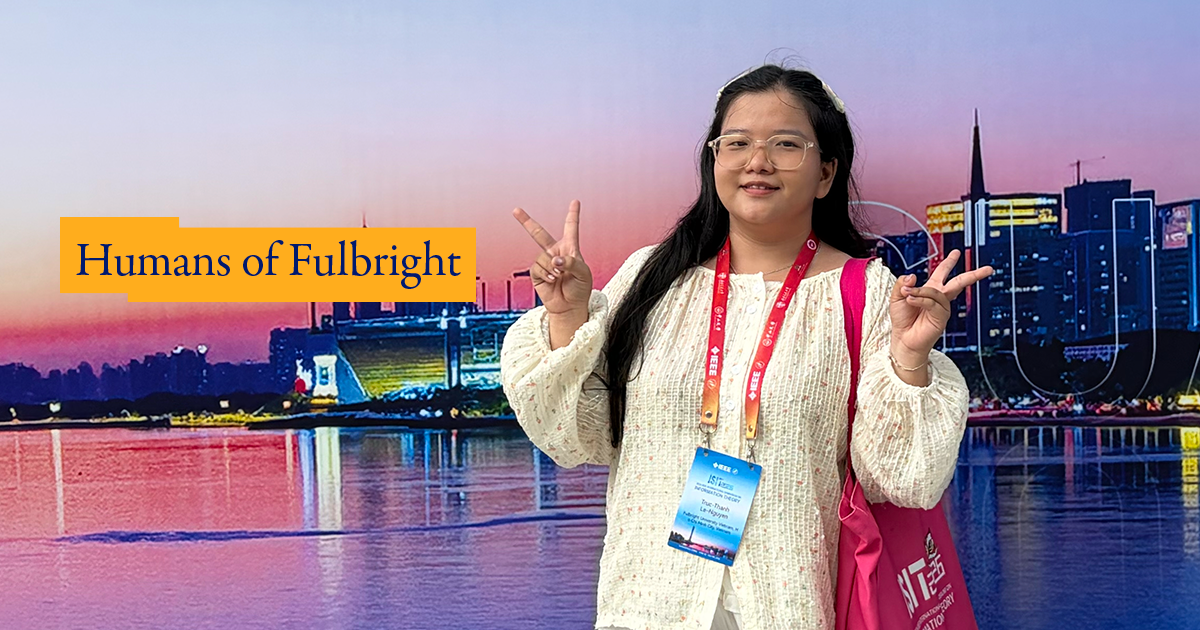
A conversation with Thanh Trúc, a Class of 2027 student majoring in Applied Mathematics, following her participation in the 2026 IEEE International Symposium on Information Theory (IEEE ISIT 2026) in Guangzhou, China, with support from the Fulbright EPiC Fund.
Some journeys take us to new places. Others help us discover a new version of ourselves. For Thanh Trúc, attending an international academic conference for the first time was not only an opportunity to present her research to the global academic community. It was also a transformative experience that led her to realize: “Sometimes, all it takes is the courage to take the first step—and the world may open up in ways you never imagined.”
Fulbright sat down with Thanh Trúc after her return from China to hear more about her journey.
What led you to IEEE ISIT 2026 and to this research project?
I had the opportunity to attend the conference because my paper was accepted for presentation at the 2026 IEEE International Symposium on Information Theory (ISIT) [1] following a rigorous peer-review process.
This was also the first research project I had worked on that could lead to an international publication. The journey began at a summer school, where I met my research supervisor, Dr. Bùi Văn Thạch, a faculty member in the Faculty of Information Technology at the University of Science, Vietnam National University Ho Chi Minh City. From that starting point, I continued pursuing the project with persistence and under his dedicated guidance, eventually achieving the result I have today.
For me, the greatest value of this process was not simply having my paper accepted. It was learning how to formulate research questions, approach an open problem, and persist in searching for a solution.
Could you tell us more about the research you presented at the conference?
My presentation was titled “Estimating Number of Complexes in Complex Group Testing.” The research focuses on estimating the number of “complexes” within the Complex Group Testing model. This model extends traditional Group Testing and aims to minimize the number of tests required while still obtaining all the necessary information.
In terms of my long-term academic interests, I am particularly drawn to the intersection of mathematics and computer science, especially areas such as optimization, probability, information theory, algorithms, and artificial intelligence.
How did you feel attending such a major international academic conference for the first time?
I was both excited and nervous. It was my first time attending an international conference and presenting my own research to professors, researchers, and students from many different countries.
When I entered the registration area and held my name badge bearing the words “Fulbright University Vietnam,” I finally felt that the journey had truly begun. I still remember asking myself, “Can I really do this?”
What was the most memorable moment of the conference?
It was the day I presented my research at ISIT 2026. The experience was incredibly meaningful and helped me become more confident in academic discussions within an international environment. I arrived early to prepare and introduce myself to the session chair.
Although I was very nervous because it was my first presentation at such a major conference, everything went smoothly. Afterward, I received a fascinating question about the project’s potential future directions. This led to a deeper discussion with Professor Yuichiro Fujiwara and a doctoral student from his research group. We have remained in touch ever since.
I came to understand that the value of a conference lies not only in the presentations themselves, but also in the conversations that can open up new opportunities and inspire future research.
What did you learn beyond the academic sessions?
Perhaps the most valuable experiences came from the time I spent outside the conference rooms. The Welcome Reception and tea breaks gave me opportunities to meet participants from China, Bangladesh, the United States, and many other countries. Although most of them were graduate students or doctoral researchers, everyone was very open. They were willing to share their research interests and listen to my story.
After each day of the conference, I spent time exploring Guangzhou. If the conference allowed me to learn from researchers, the city became a different kind of classroom—one in which every street, metro journey, and conversation offered something new. What impressed me most was how Guangzhou combines modernity with a strong sense of tradition.
Although I do not speak Chinese, I was able to communicate using English and Google Translate. What surprised me most was the warmth and willingness of local people to help whenever I needed assistance.
What made you feel that you had grown through this journey?
Before the trip, my greatest concern was traveling alone for the first time to a country where I did not speak the local language. I prepared extensively—from travel documents, maps, and payment apps to a few basic phrases in Chinese. But I eventually realized that no amount of preparation could help me grow as much as actually stepping outside my comfort zone.
There were moments when things did not go according to plan. On the evening before my presentation, I encountered an Internet problem just as I needed to revise my slides. Fortunately, the people around me readily offered their help, and I was able to finish everything in time.
Small moments like these helped me appreciate the kindness of others and become more confident in my own ability to adapt.
What is the most valuable thing you brought home from this journey?
What I brought home was not a few souvenirs or hundreds of photos on my phone. It was greater confidence in my ability to work in an international environment, the realization that I could share my research with a broader academic community, and a deeper openness to different cultures.
Looking back, I realized that all the quiet effort I had put in over the preceding months was truly worthwhile. I believe that sometimes, all it takes is the courage to take the first step—and the world may open up in ways you never imagined.
I would like to express my sincere gratitude to the Fulbright EPiC Fund and the Global Engagement team at Fulbright University Vietnam for supporting my participation in IEEE ISIT 2026. I am also deeply grateful to Dr. Bùi Văn Thạch, who guided and supported me throughout the research process, and Dr. Trần Vĩnh Linh, Dean of the Undergraduate Program at Fulbright, who gave me the confidence to embark on this journey.
I hope this milestone will mark the beginning of many more research journeys and even greater learning opportunities in the future.
[1] About IEEE ISIT: The 2026 IEEE International Symposium on Information Theory (ISIT) is one of the world’s leading annual conferences in information theory. It brings together researchers, faculty members, and students from around the world to share the latest findings in the field. Having a paper selected for presentation at ISIT means that the work has successfully passed a rigorous scientific peer-review process conducted by an expert committee.