
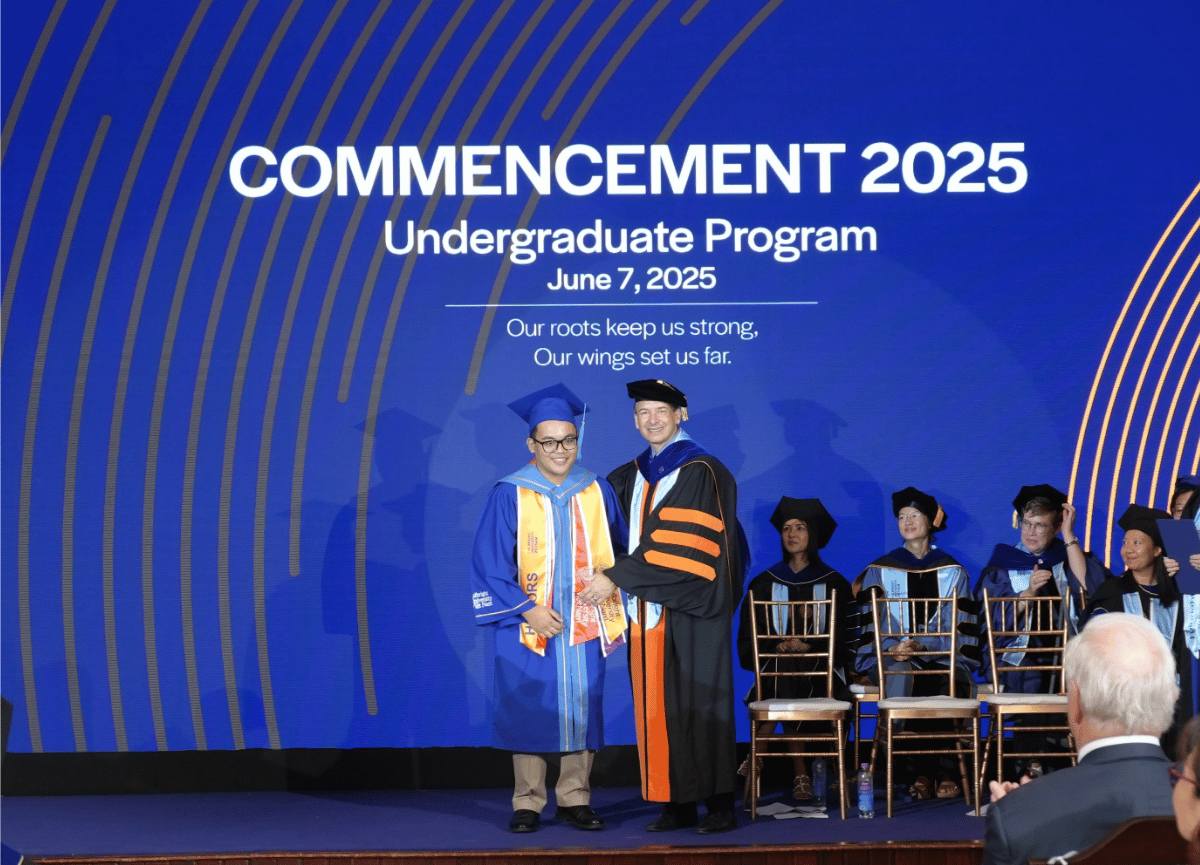
Born and raised in Huế, Trần Công Đại (Class of 2025) came to Fulbright University Vietnam with a background in the natural sciences. During his time at the university, he made a decisive shift to History and gradually carved out his own research path. Recently, Đại received multiple offers of admission to fully funded PhD programs in History from universities in the United States, along with acceptances to master’s programs in the United Kingdom and Singapore.
From physics classrooms to a path in historical research
Đại grew up in a family connected to the printing trade. His childhood was surrounded by stacks of printed materials—from state publications to propaganda posters—objects that carried the imprint of a particular historical moment. This environment sparked an early curiosity about the past and the stories embedded within these pages.
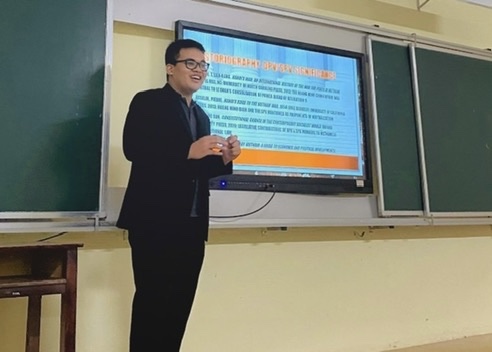
At Quốc Học Huế High School for the Gifted, Đại pursued Physics and earned several provincial-level awards in science and engineering competitions as well as public speaking contests. Yet his interest in history continued to grow quietly in the background. It was only when he had the chance to engage more deeply with the field at Fulbright that he realized how drawn he was to uncovering untold stories of the past.
In the summer of his first year, Đại stepped into an archive for the first time, working directly with primary historical sources. That experience reshaped his understanding of what it means to study history—not simply reading texts, but tracing fragments of the past to understand how societies take shape and evolve. From that point on, the ambition to become a historian began to take clear form.
Studying Vietnam within a global historical context
At Fulbright, Đại pursued a double major in History and Social Studies, focusing on modern Vietnamese history within the broader context of global history and international communist movements.
His honors thesis examined structural transformations of the “united front” in Vietnam during the late Cold War and the Đổi Mới period. This meticulous work led to invitations to present at the Historical Materialism Conference on East and Southeast Asia (2025) in Thailand and the Southeast Asian Studies Conference (2025) at the University of Cambridge in the United Kingdom.
These opportunities allowed Đại to bring his research into international academic conversations, while also opening up long-term research questions on the history of postcolonial state formation in Vietnam. With rigorous methodological training and a grounded understanding of Vietnamese society, he hopes to contribute more nuanced perspectives on Vietnam to global scholarly discourse.
At a time when much of the scholarship on Vietnam has been produced by international researchers, the emergence of young Vietnamese historians represents an important step toward broadening and deepening how Vietnam is understood in the world.
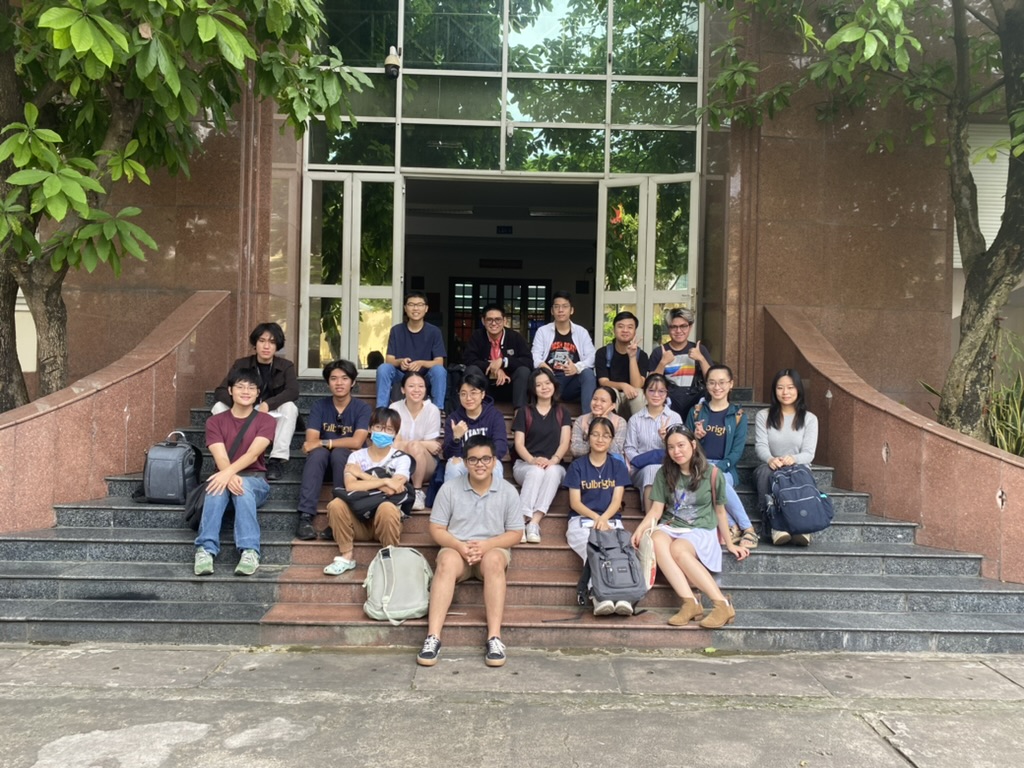
Offers from leading universities around the world
During his time at Fulbright, Đại also served as a teaching assistant for several courses, gaining firsthand insight into academic life. He credits much of his development to the mentorship of faculty members such as Dr. Vũ Minh Hoàng, Dr. Tobias Burgers, and Dr. Elsa Costa, who have played an important role in shaping his research journey.
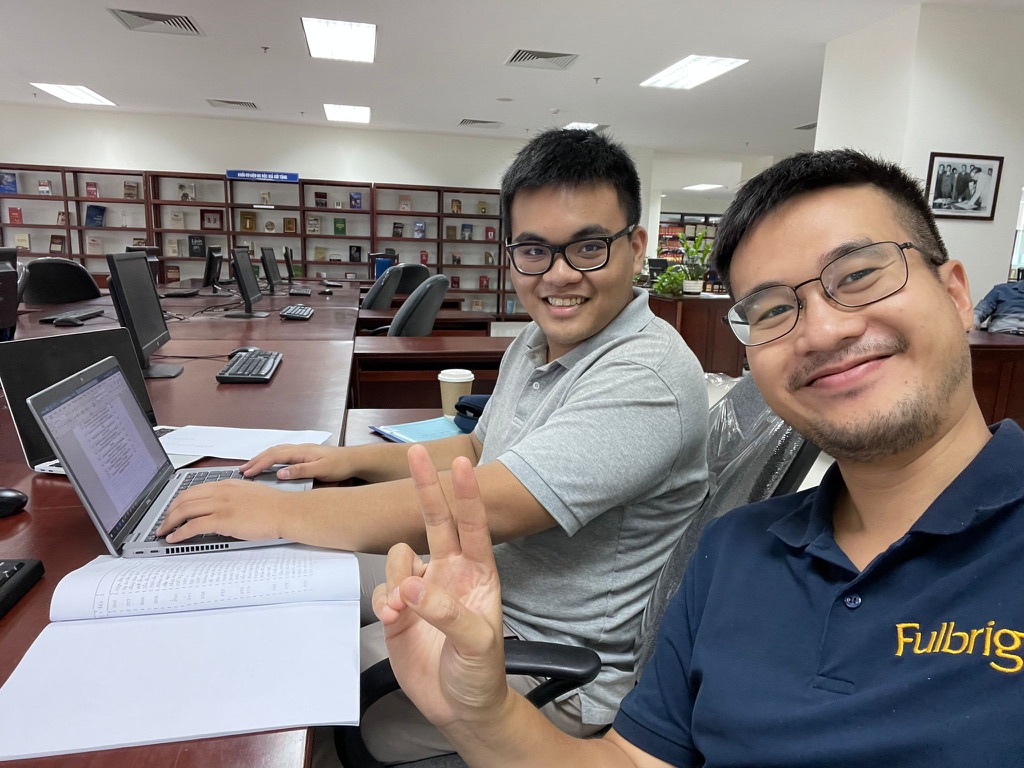
Trần Công Đại with Dr. Vũ Minh Hoàng, Faculty member in History

Trần Công Đại with Film director Tony Bùi.
Đại has also contributed to historical research projects led by scholars at the Council on Foreign Relations (New York, USA), the Weatherhead East Asian Institute (USA), and filmmaker Tony Bùi.
He has recently received fully funded PhD offers in History from Columbia University, The University of Texas at Austin, and The Ohio State University, with a research focus on modern Vietnamese and East Asian history. In addition, he has been admitted to the MPhil in World History at the University of Cambridge (UK) and a Master’s program in Asian Studies at Nanyang Technological University (Singapore).
Looking ahead, Đại recognizes that an academic path will come with its share of challenges. But for him, studying history is not only about reading and writing—it is a way to bring Vietnamese voices more fully into global historical knowledge, where Vietnam is understood not only through the lens of war, but as a dynamic society with rich and complex historical experiences.