
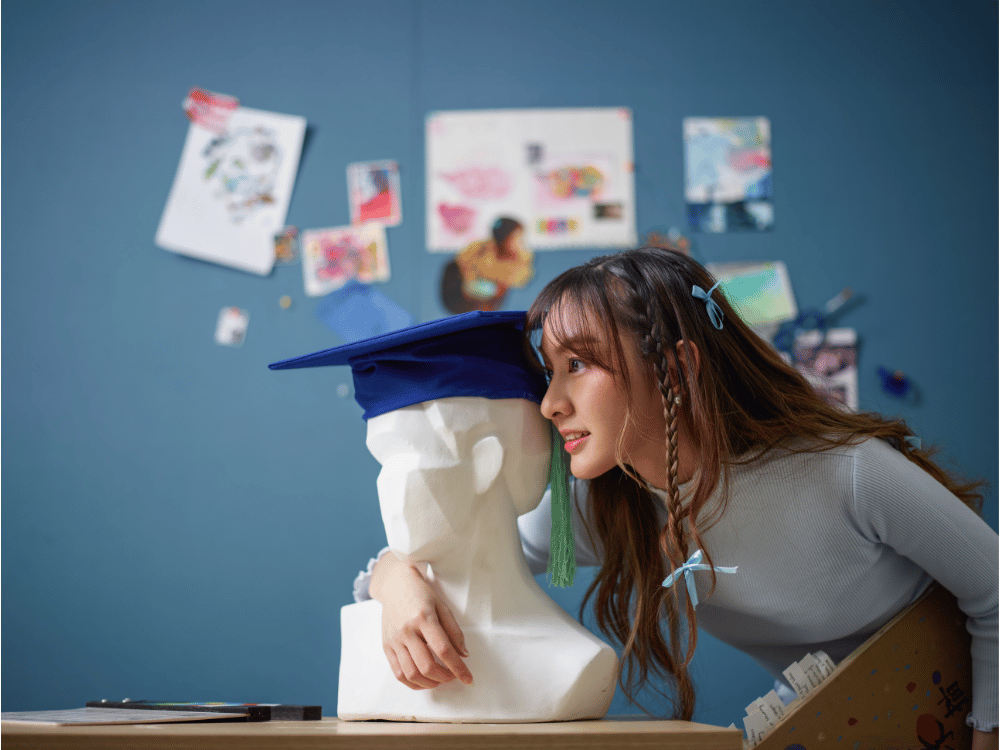
Two generations, one shared belief. Mai Nguyen To Nhu’s father was among the first cohorts of the Fulbright Economics Teaching Program. More than twenty years later, his daughter pursued a bachelor’s degree in Media and Arts Studies at Fulbright itself — and that four-year journey has now led her to five Master’s offers from some of the United Kingdom’s most prestigious art institutions.
It all began with a question
When she was still in high school in Bien Hoa, Nhu knew she loved the arts, but she did not yet know in what form. Design, theory, and art history all remained open possibilities. Rather than rushing to choose a direction, she chose an environment where she did not have to know right away.
“I applied because I wanted to study in order to understand what I truly wanted,” she shared. “I believed that by starting from a broad foundation, I would eventually discover what genuinely resonated with me.”
That choice also carried personal meaning. Nhu’s father, Mr. Mai Van Nhon, was among the earliest students of the Fulbright Economics Teaching Program (FETP), the predecessor of the Fulbright School of Public Policy and Management. He is also a mosaic artist, known for creating the portrait series of 21 leaders from APEC member economies, selected by the Vietnamese government as an official national gift in 2017.
For Nhu’s family, art and critical thinking were never separate pursuits. “My father often says Fulbright teaches people, not just professions,” Nhu reflected. “It helps learners build the foundational values needed to become thoughtful and grounded human beings.”
At Fulbright, Nhu explored a wide range of artistic directions, from film theory and history, East Asian cinema, and visual arts to curatorial practice and art history. At one point, she was almost certain she would pursue graduate studies in film. But she never forced herself to choose too early. Rather than leaving her lost, that breadth of exploration became the very foundation that later helped her recognize what she truly wanted when the right opportunity arrived.
A moment of clarity during an exchange semester in Birmingham
The turning point came in her senior year, when Nhu joined an exchange semester at the University of Birmingham. Courses on global art history, museum studies, and the art market opened up an entirely new dimension for her.
From there, she intentionally stepped beyond the classroom. She visited art fairs, spoke with gallery owners in London, observed how artworks were valued inside auction houses, and spent long hours in museums studying how exhibitions were curated and how stories were constructed around art.
Through these experiences, Nhu realized that every artwork lives two lives: one inside the artist’s studio, and another once it enters the world — where it is valued, collected, and interpreted.
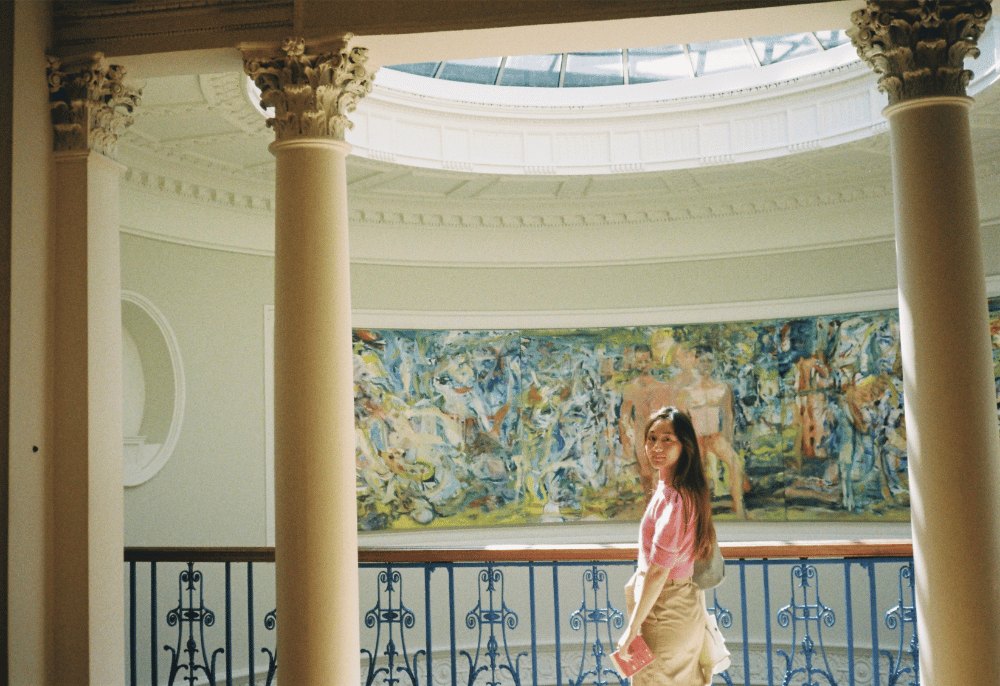
“The market is, in many ways, a form of public education,” she explained. “If academia is about deep research, then the market is also a practice of bringing those studies to collectors and the public, helping artworks find their place on the global map.”
That was when Nhu understood she did not simply want to study art as an academic discipline. She also wanted to understand how art operates in the real world — where cultural values, history, and market systems intersect.
When art needs people who know how to value it
After returning to Vietnam, Nhu worked at Indochine House, a gallery specializing in antiques, Indochina-era masters, and contemporary Vietnamese artists. At the same time, she spent six months after work refining her graduate school applications.
Her decision to work for a year before continuing her studies was intentional.
“I wanted to immerse myself in the flow of the real world,” she said. “I wanted to understand what collectors and audiences are looking for, where the Vietnamese market currently stands, and what I might be able to contribute.”
Academia taught Nhu to ask: What does this artwork mean within the broader flow of history? The market pushed her to ask another question: How can that value be recognized, protected, and sustained?

To her, these questions are not opposites, but complements. The market, she believes, becomes a form of public-facing education, where academic research reaches collectors and audiences, allowing artworks to gain visibility and lasting presence on the global stage.
Throughout this journey, Nhu received close mentorship from Dr. Pamela Corey, Dr. Linda Zhang, and Richard Streitmatter-Tran at Fulbright. She shared that their support and expectations became a major source of motivation throughout her studies.
Ultimately, Nhu secured five Master’s offers from the UK’s leading institutions: History of Art at University College London (ranked 9th globally); History of Art and Archaeology at SOAS University of London; both History of Art and Art Business at The Courtauld Institute of Art (ranked 1st globally for the subject); and Art Business at the Sotheby’s Institute of Art
In the coming months, Nhu plans to pursue the Master’s in Art and Business at The Courtauld. Her research will focus on how transnational Vietnamese artists — those exploring migration, memory, and identity through contemporary artistic language — are positioned and valued within the international art market.
What concerns her most is how Vietnamese contemporary artists can move beyond being momentary phenomena to achieving enduring presence internationally, and how Southeast Asian art, with all its depth and complexity, can be introduced to global audiences without losing its cultural roots.
For Nhu, this is both an ethical and aesthetic question — one she hopes to continue exploring throughout her graduate studies.
Yet amid these reflections, she still holds onto a genuine excitement for the path she has chosen. She loves the atmosphere of auctions and art fairs, where value becomes tangible, layered beneath histories, cultures, and human stories.
To her, standing at the intersection between academic language and the art-loving public is an energizing and deeply creative role.
For young people hoping to follow a similar path, Nhu encourages them to begin by building an interdisciplinary lens and learning to observe systems.
“Don’t just look,” she said. “Ask how an exhibition is organized. Ask how an artwork is auctioned. The best preparation is a combination of strong foundational knowledge and real-world experience.”
Nhu’s journey did not begin with a clearly defined destination. But perhaps that is exactly what allowed her to go further than any plan she could have imagined.